


Key Points
- The total egress window cost includes the window unit, foundation cutting, labor, a window well, drainage, and permits.
- Basement egress window installation is more expensive than above-grade installs because it almost always requires excavation and a reinforced window well.
- Window type and material are major cost drivers — vinyl windows start around $800, while wood-framed options can reach $3,500.
- A properly installed egress window can convert unfinished basement space into a legal bedroom, with an ROI of 50–300% in many markets.
- Choosing standard sizes can meaningfully reduce material costs. Getting 3+ competitive quotes — through HomeBuddy or independently — reduces the final price.
What Is an Egress Window and Why Does It Matter More Than You Think?
An egress window is not just a basement window. It's a code-mandated emergency exit — large enough for an adult to climb out, or for a firefighter to climb in. The International Residential Code (IRC), Section R310, sets the national baseline: basements, habitable attics, and every sleeping room must have at least one operable emergency escape and rescue opening.
The minimum IRC specs are:
If your basement has a bedroom without a compliant egress window, that room cannot legally be marketed or appraised as a bedroom. And in many states, it may violate your homeowner's insurance terms.
Note: A window meeting only the minimum width and height is 3.3 sq. ft. and will not meet code; at least one dimension must be larger to reach 5.7 sq. ft.
Breaking Down the Real Egress Window Cost: Where Your Money Goes
Understanding what drives the final cost helps you budget realistically and avoid surprise charges. The cost of a basement egress window installation involves much more than just buying a window — it is a small construction project that typically requires excavation, concrete cutting, skilled carpentry, and permits.
Window Size and Type: The Starting Point for Your Budget
The window unit itself typically costs $150–$700 for standard sizes. The price for larger, custom, or premium-glazed units is higher.
| Window Type | Avg. Unit Cost | Notes |
|---|---|---|
| Casement | ~$560 | Most popular; opens fully; ideal for egress |
| Double-hung | ~$500 | Must be extra tall; opens only half at once |
| Single-hung | $150–$400 | Budget option; limited opening |
| In-swing | $300–$600 | Good for a tight exterior space |
| Sliding/horizontal | $200–$500 | Code-compliant only in larger sizes |
Glass quality plays a big role here. Single-pane glass costs $100–$400 per window. Double-pane — the choice of over 77% of homeowners, according to a 2025 industry survey — is $200–$500 and delivers meaningful energy savings and noise reduction. Triple-pane windows cost $500–$1,000, but are generally overkill for a basement unless you're in an extreme climate.
Frame material also affects the price. Vinyl frames are the most affordable and low-maintenance. Wood and fiberglass cost more but offer superior insulation and curb appeal.
Labor Costs: The Biggest Line Item You Can't Ignore
Labor is typically the highest single cost in any basement egress window installation. Contractors charge $40–$120 per hour, with significant regional variation — labor in San Francisco or New York can be 30–50% more expensive than in the Midwest.
The most labor-intensive (and expensive) task is cutting through a concrete or masonry foundation wall. Cutting through poured concrete is slower and more technically demanding than cutting a concrete block foundation, which affects your bill. A simple installation where a basement already has a window of the right rough-opening size costs around $200 in labor alone. A full cut-and-install on a poured concrete foundation with excavation can cost $1,000–$2,500 in labor.
Most projects take one to three days from start to finish.
Permits and Inspections: The Cost You Can't Skip
Building permits for basement egress window work typically cost $100–$500, depending on your municipality. Some simpler above-grade replacements can be cheaper — as low as $50 in some areas.
This isn't optional. Skipping a permit creates real problems: failed home inspections during a sale, insurance liability if someone is injured, and the cost of redoing unlicensed work. Always check your local requirements and specifications.
Additional Costs to Consider
What Is Actually Being Installed: Components You're Paying For
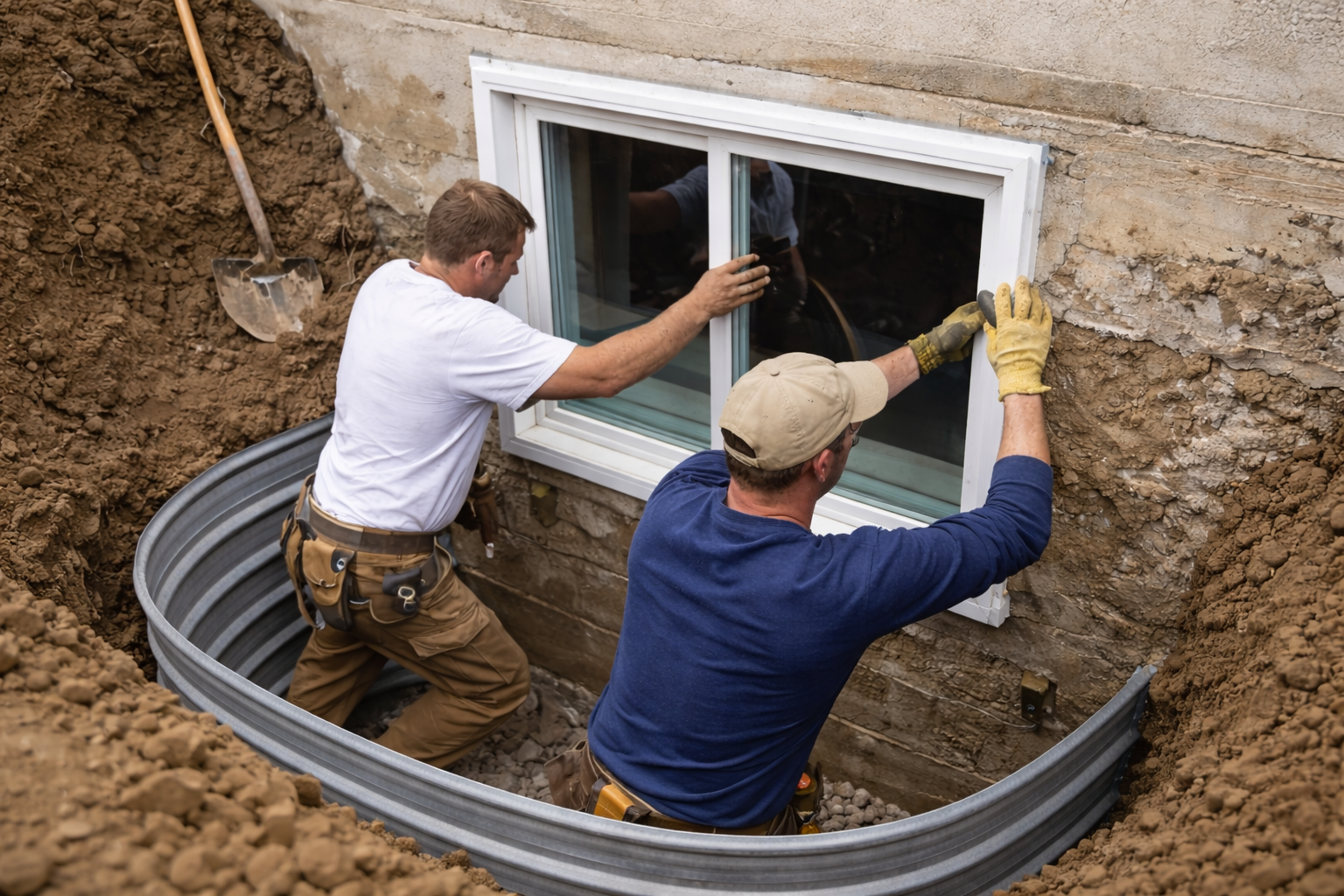
A properly installed basement egress window is more than a hole in the wall. Here's what goes into a code-compliant system:
Skipping any of these components usually results in a failed inspection, water damage, or a window that doesn't qualify as an egress window.
DIY vs. Professional: What Option Actually Saves You Money?
Experienced builders can save $1,000–$2,500 in labor costs by doing the project themselves. However, cutting through a foundation wall requires a concrete saw or core drill (rental: ~$100–$300/day), structural awareness, and proper waterproofing technique — a bad cut or poor seal can cause long-term moisture damage worth far more than the labor savings.
A smarter hybrid approach: handle the excavation yourself — though be sure to call 811 to locate utilities first and assess soil stability — then hire a pro for the foundation cut, window installation, and drainage. This middle-ground option typically reduces the total cost to install an egress window to around $3,300, compared to $4,000–$7,000 for a fully professional job.
What Full Professional Installation Really Costs
Professional installation offers several advantages that justify the higher egress window installation price:
6 Questions Every Homeowner Should Ask Before Signing
Before you commit to a contractor, ask these questions directly:
HomeBuddy connects homeowners with pre-screened, verified local contractors — so you can compare answers from multiple installers without making a dozen cold calls.
Long-Term Benefits of Installing an Egress Window
The upfront cost looks different once you account for the long-term benefits:
Conclusion
Adding a proper emergency exit to your basement is one of the most practical improvements you can make. While the basement egress window installation cost might seem high initially, the safety it provides for your family in case of a fire is invaluable. Beyond safety, it transforms a dark, uninviting basement into a bright, legal living space, significantly enhancing your property's market value.
When you're ready to move forward, HomeBuddy makes it simple to connect with pre-screened local egress window installers who can give you accurate, competitive estimates — no guesswork required.
Frequently Asked Questions
How Much Does It Cost to Dig Out an Egress Window?
Excavation is priced by the cubic yard — typically $50–$200 per cubic yard. Most basement egress window projects require excavating 2 to 4 cubic yards, but once you factor in equipment, labor, soil disposal, and backfilling around the new window well, the excavation component of a below-ground project typically costs $1,500–$3,000.
Does Every Basement Need an Egress Window?
Not automatically. The IRC requires an egress window in any basement room used as a sleeping area or habitable space. Unfinished storage areas don't require one. But if you're finishing the basement or adding a bedroom, an egress window stops being optional. And if an inspector finds a basement bedroom without one, or a finished basement lacking any emergency escape, you'll be required to install it.
Does Adding an Egress Window Increase Your Home's Value?
Yes, often substantially. An egress window that unlocks a legal basement bedroom can add $10,000–$50,000 to a home's market value, depending on location, local home prices, and basement square footage. Even without a bedroom conversion, egress windows improve buyer appeal, safety ratings, and livable square footage perception. ROI typically runs 50–300% of the egress window cost.
Do You Need a Permit to Install an Egress Window?
Yes, in virtually every jurisdiction. Because the work involves cutting into a structural foundation wall, a building permit is required. Budget $100–$500 for the permit and $50–$300 for the inspection. Always confirm that your contractor will pull the permits — unpermitted structural work creates serious complications during refinancing, home sale inspections, or future renovations.
Is the Investment Worth It?
For most homeowners, yes — especially if the basement is used as a bedroom or living space. The average cost to install egress windows runs $2,700–$6,000 for a typical project, and the combination of legal bedroom status, improved livability, safety compliance, and resale value usually justifies the expense.